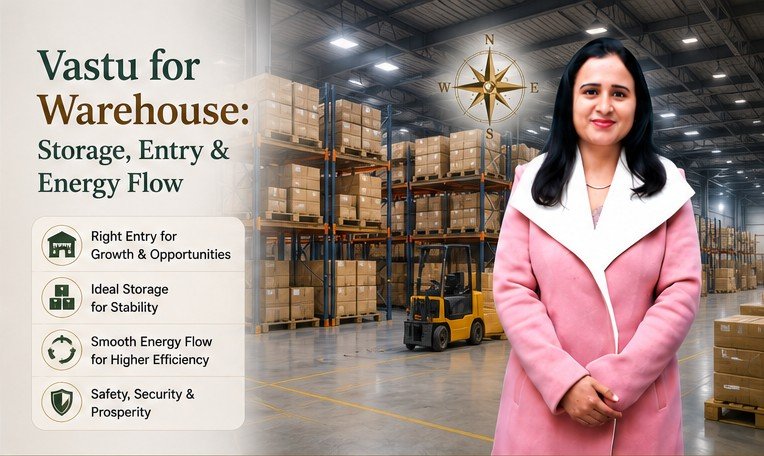
Warehouse Vastu: How Layout Affects Your Business Flow

Acharya Nehha
Vastu ExpertA warehouse is more than a storage facility — it's where your business inventory lives, moves, and generates value. The energy flow in a warehouse directly affects how smoothly goods arrive, get stored, and go out. Vastu for warehouses is about aligning that physical flow with directional principles that support consistent business operations.
Entry Gate and Goods Movement
The main entry gate for a warehouse should face North or East. North is the direction of wealth and incoming prosperity — goods entering from the North direction are aligned with growth energy. East also works well, bringing in fresh, active energy that supports receiving and processing.
If your warehouse has a West-facing main gate, it's generally acceptable — West is a stable, receiving direction for goods. South-facing main gates are more challenging; if this is your situation, specific remedies around the gate and layout management become important. A secondary gate on the South side for outbound goods is actually quite aligned with Vastu — South is a natural exit direction.
The loading and unloading dock can be on the West or South side of the warehouse. Heavy, outgoing, or waste-related activity in the South or West is appropriate — these are the heavier, outward-movement directions.
Storage Zone Planning
Vastu has very clear guidance on where heavy versus light goods should be stored. Heavy goods, raw materials, and dense inventory belong in the South, South-West, and West zones. These are the heaviest energy zones — the most structurally and energetically appropriate places for heavy physical weight.
Light goods, fast-moving inventory, and goods ready for dispatch should be in the North or North-West area. The NW is the zone of movement and outward flow — goods stored here tend to move out faster. This isn't coincidence; the directional alignment of storage affects the pace at which inventory turns over.
The NE corner of the warehouse must never be used for heavy storage, waste, or machinery. This is the single most consistent error I see in warehouse Vastu assessments. The NE is the Ishanya zone — it must remain light, open, and unobstructed. Factories and warehouses that have heavy equipment or rubbish in the NE corner consistently struggle with operational delays and inventory problems.
Share your floor plan — Acharya Nehha will assess entry direction, storage zones, office placement and operational flow.
WhatsApp Your Floor Plan Book Consultation
Office and Staff Areas Within the Warehouse
If there's a manager's office or admin area within the warehouse, it should be in the South-West. The manager sitting in SW faces North or East while working — oriented toward the wealth and growth directions. This consistent placement of authority in the SW is a foundational Vastu principle across all commercial spaces.
Staff rest areas and canteen facilities should be in the West or North-West. The NW supports temporary gathering and outward movement — an appropriate zone for staff who are between shifts or tasks. Avoid placing staff canteens in the NE, which should remain uncluttered.
Internal pathways within the warehouse should always be kept clear. In Vastu terms, blocked pathways represent blocked business flow. If goods are stacked in the aisles or movement through the warehouse is constantly obstructed, this creates a practical and energetic blockage. Clear pathways are one of the simplest, highest-impact improvements in any warehouse Vastu assessment.
For industrial spaces of any scale, our industrial Vastu consultation provides on-site assessment with compass-accurate zone mapping. You can also read our broader guide on Vastu for factories and industrial units.
At Prestigious Vastu, we assess warehouses with full zone mapping — entry, storage hierarchy, office placement and internal flow.
Book Your Warehouse AssessmentFrequently Asked Questions
Common questions answered clearly.