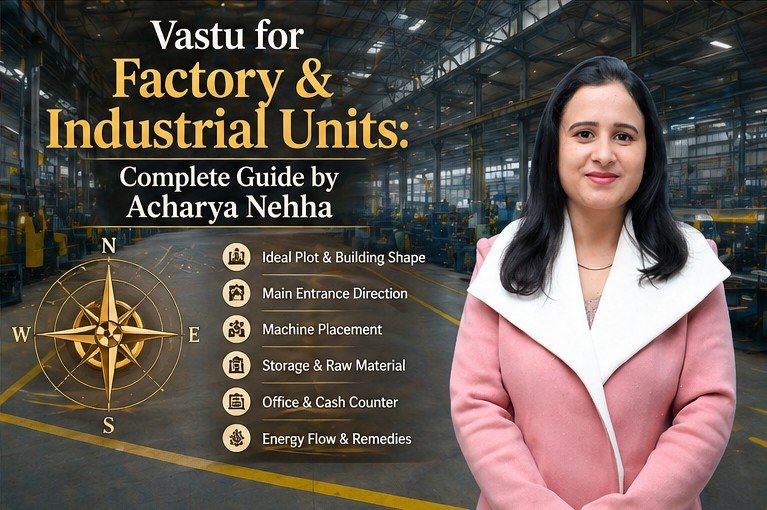
Vastu for Factory & Industrial Units: Complete Guide by Acharya Nehha

Acharya Nehha
Vastu ExpertWhy Industrial Vastu is Different
Factory Vastu differs fundamentally from residential Vastu. The scale is larger, the energy interactions are more complex, and the consequences of Vastu defects — production losses, accidents, workforce unrest, financial drain — are far more serious. Industrial Vastu focuses on optimizing energy flow across large spaces to improve productivity, safety, workforce harmony, and profitability.
Acharya Nehha has personally visited and assessed factories, manufacturing units, and warehouses across India, bringing a unique blend of classical Vastu knowledge and practical industrial understanding. Her industrial Vastu consultations are trusted by factory owners and business leaders seeking real, measurable improvements in their operations.
Unlike residential Vastu where a few directional corrections suffice, an industrial unit requires a zone-by-zone assessment — covering the entry gate, administrative block, production floor, raw material storage, fire and electrical zones, worker facilities, and the sacred center (Brahmasthan) of the plot. Getting any one of these wrong can cascade into operational disruptions.
Entry Gate Direction
The main entry gate is the most critical Vastu point for any factory. It is the primary channel through which energy, opportunities, clients, and finances enter the premises. Getting this right sets the foundation for everything else.
- North, East, or North-East gates are considered most auspicious — they welcome prosperity, growth, and smooth flow of business.
- South gates are acceptable only if they align with the South of South-East (SSE) sub-zone.
- South-West main gates are to be avoided at all costs — they are associated with financial instability, leadership challenges, and recurring losses.
If your factory currently has a South-West gate, specific energy correction measures and remedies can neutralize its negative effects without requiring structural demolition. An industrial Vastu assessment will identify the precise corrective actions needed.
Administrative Office Placement
The owner's or management cabin should be in the North-East or North zone of the factory. This position enhances wisdom, clarity, and effective decision-making.
- The North zone governs career growth and wealth flow — positioning the management here supports strategic thinking and business expansion.
- Middle management can be placed in the East zone, which is good for communication and coordination.
- Avoid placing the owner's cabin in the South or South-West — while these are stable zones, they may create overly rigid thinking or ego-based conflicts over time.
The accounts and finance department should ideally be placed in the North zone to support wealth flow and accurate financial management.
Machinery Placement
Heavy machinery and production equipment should be placed in the South, South-West, or West zones. These zones offer structural stability and grounding energy, which reduces mechanical breakdowns and increases operational consistency.
Avoid placing heavy machinery in the North-East — the lightest energy zone — as it disrupts the sacred and clear energy that should reside there. Factories that have heavy presses, boilers, or CNC machines in the North-East frequently report unexplained mechanical failures and production downtime.
- South zone: Heavy production machinery, stamping machines, presses
- South-West zone: Heaviest and most permanent equipment, large storage tanks
- West zone: Mid-weight equipment, assembly lines, packaging machinery
- North-East zone: Keep light, clean, and open — ideally a small prayer area or open space
Raw Material Storage
The South-West zone is the ideal location for storing raw materials and inventory. South-West governs stability, weight, and retention — meaning materials stored here are less likely to be wasted, mismanaged, or lost to theft.
Avoid storing materials in the North-East, as this creates stagnation in the most sacred zone and blocks the flow of prosperity into the factory. Finished goods can be stored in the North-West zone — the zone of movement — which encourages quick dispatch and sales.
Not sure how these Vastu tips apply to your space? Acharya Nehha offers personalised consultations — online and on-site across India.
WhatsApp Now Book Consultation
Workers' Area & Toilets
Worker rest areas and toilets should always be in the South or South-West zones. Placing toilets in the North-East is a serious Vastu defect that drains positive energy and often correlates with worker unrest, frequent absenteeism, and health-related issues on the floor.
Ensure that no toilet is placed in the center of the building (the Brahmasthan). The Brahmasthan — the central zone — should be kept as open, clean, and unobstructed as possible. Any heavy construction, toilet, or storage in the center blocks the vital energy circulation of the entire factory.
Water Source & Water Storage
Borewell, water tanks, and other water storage should be placed in the North-East or North zones. Water represents flow, clarity, and wealth — positioning water elements in the North-East aligns them with the zone of wisdom and divine energy, amplifying their positive influence.
- Underground water tanks: North-East or North
- Overhead water tanks: North-West (acceptable) or West
- Avoid water bodies in the South, South-East, or South-West — these create conflict between elements (fire vs water) and can lead to financial losses and health issues
Fire & Electrical Equipment
Electrical panels, boilers, generators, and all fire-related equipment should be in the South-East (the Agni zone) — ruled by the fire element. This is the most natural zone for fire energy.
Placing fire elements in the South-East reduces the risk of electrical failures, short circuits, and fire accidents significantly. Factories that have electrical panels or boilers in the North-East or North zones tend to experience frequent power disruptions and electrical accidents.
- South-East: Main electrical panel, DG sets, boilers, furnaces, welding stations
- Avoid: Electrical installations in the North-East or North zones
- East zone: Acceptable for secondary electrical distribution panels
Common Industrial Vastu Mistakes
These are the most frequently observed Vastu defects in factories and manufacturing units across India:
- South-West main gate — causes financial instability and leadership challenges
- Toilets in North-East — blocks positive energy, worker unrest, absenteeism
- Heavy machinery in North-East — disrupts prosperity zone, frequent breakdowns
- Owner's cabin in South-East — reactive decision-making, conflict-prone management
- Water storage in South — fire element conflicts with water, safety hazards
- No open space in North or East — blocks wealth energy flow and new opportunities
- Irregular or L-shaped plot without compensation — energy leakage, resource waste
- Broken or dim main gate lighting — blocks incoming positive energy and business prospects
Many of these defects can be corrected without major structural changes. A skilled industrial Vastu consultant can identify energy-balancing remedies — including placement of specific symbols, colours, plants, and elemental corrections — that neutralize existing defects. Explore our commercial Vastu services if your business operates from a commercial premises rather than a dedicated factory.
When to Get an Onsite Industrial Vastu Visit
If your factory is experiencing any of the following, it is time for a professional industrial Vastu assessment:
- Recurring production losses despite adequate capacity
- Unexplained machine failures and frequent downtime
- High absenteeism and workforce conflicts
- Workplace accidents and safety incidents
- Financial drain despite good order books
- Business stagnation — growth plateau with no clear reason
- Key personnel leaving or management disputes
- Recent expansion that has not yielded expected results
Acharya Nehha provides both onsite and online industrial Vastu consultations across India. Online consultations are conducted using detailed floor plans, compass readings, and photographs — delivering comprehensive, actionable Vastu reports for factories of any size.
Ready to transform your factory's energy? Acharya Nehha offers expert industrial Vastu consultations — online and onsite — for factories, manufacturing units, and warehouses across India.
View our consultation packages and pricing or reach out directly to get started.
Book Industrial Vastu ConsultationFrequently Asked Questions
FAQs About Industrial Vastu & Factory Vastu Consultation.