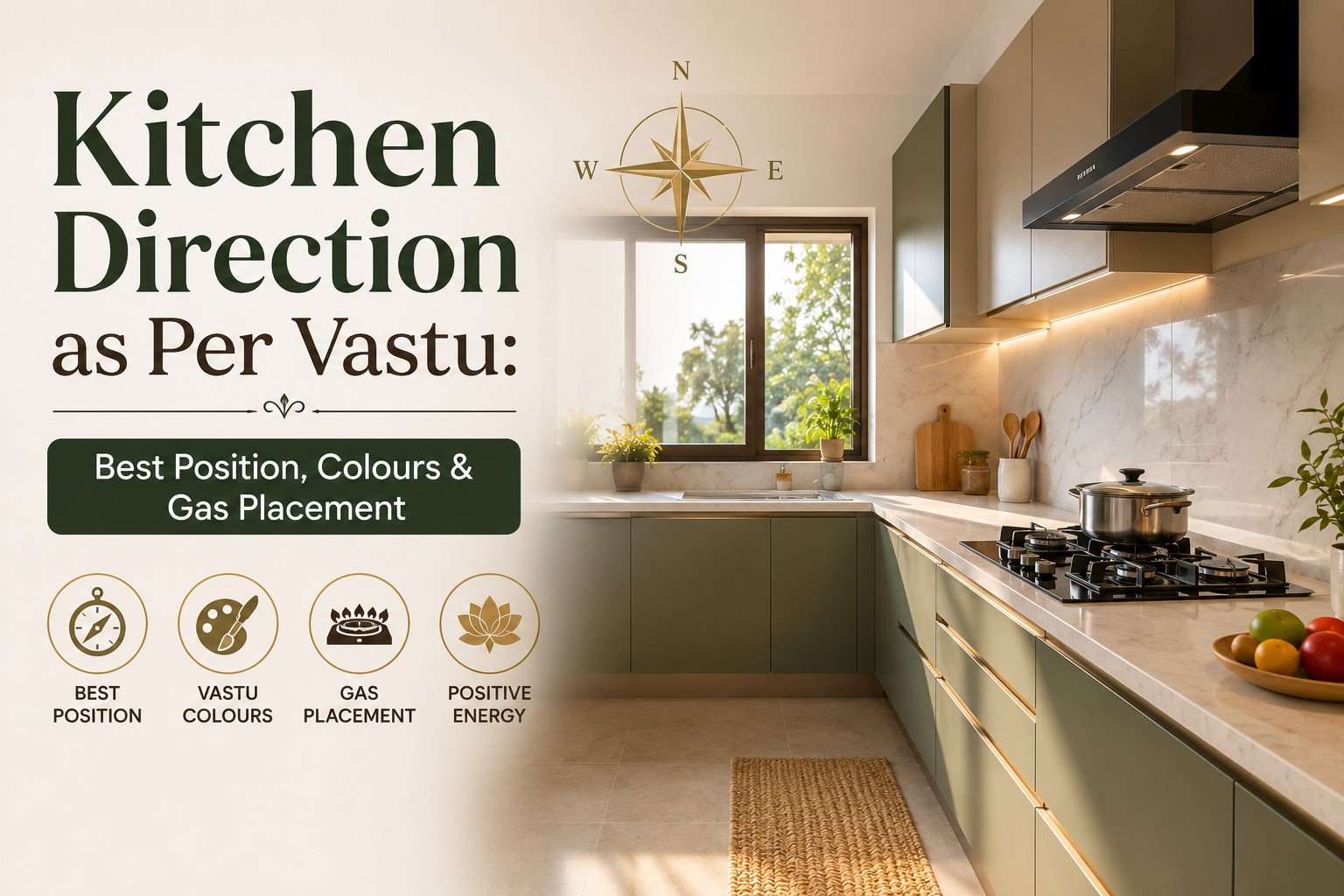
Kitchen Direction as Per Vastu: Best Position, Colours & Gas Placement

Acharya Nehha
Vastu ExpertAccording to Vastu Shastra, the South-East direction is the best kitchen direction — it is governed by the Agni (fire) element, making it the most harmonious zone for cooking activities. The North-West direction serves as a strong secondary option. Kitchen placement directly influences the health of family members, the quality of food energy, and the overall harmony of the household — making it one of the most impactful spatial decisions in any home.
Why Kitchen Direction Matters in Vastu
In Vastu Shastra, every direction is governed by a specific elemental force and deity. The placement of a kitchen — where fire is the central energy — must align with a compatible elemental zone for the space to function well. When the kitchen occupies an incompatible zone, the result is not mystical punishment but a practical mismatch of energies: overheating in certain zones, poor ventilation in others, disrupted sleep patterns, and imbalance in the home's thermal gradient.
Modern environmental design research supports many of these principles. The South-East zone of a house in the Northern Hemisphere receives intense morning-to-noon solar radiation. Using this naturally warmer, well-lit zone for cooking is sensible from both an energy efficiency and air quality standpoint — cooking fumes disperse more easily when ventilation is aligned with the prevailing warm-air flow in this zone.
Understanding why a direction is recommended — not just blindly following the rule — is the foundation of intelligent Vastu application.
The Agni Principle: Why South-East is the Ideal Kitchen Direction as Per Vastu
The South-East corner is known as the Agni Kona — the fire corner. This zone is associated with the element of fire, which aligns perfectly with the heat, transformation, and energy of cooking. In the 32-direction angular division system, the South-East zone spans from approximately 112.5° to 157.5° on the compass — a broad energetically active band that catches the transition from morning east light into intense midday radiation.
Placing the kitchen in this zone means the cooking space benefits from natural warmth, good morning light, and a thermal profile that reduces dampness and bacterial growth. The fire element in this zone is also associated with metabolism, digestion, and vitality — all of which are directly connected to the quality and energy of food prepared here.
The South-East zone (Agni Kona) is the only quadrant of the house where the fire element is naturally dominant. Placing a kitchen here means the stove's fire energy resonates with — rather than conflicts against — the zone's elemental character. This is the core logic behind the South-East kitchen recommendation.
Kitchen Direction as Per Vastu: Zone-by-Zone Analysis
Not every home offers the luxury of a South-East kitchen. Let me walk you through each major direction, what Vastu says about it, and the practical reasoning behind each assessment.
South-East Kitchen — The Gold Standard
Vastu verdict: Best choice. The Agni Kona supports fire activity, promotes good digestion in the household, and keeps the kitchen naturally warm and ventilated. The cook faces East while working, which is considered auspicious — receiving morning solar energy as food is prepared. If you have a choice during home construction or renovation, always prioritize the South-East zone for the kitchen.
North-West Kitchen — The Reliable Second Option
Vastu verdict: Good secondary choice. The North-West zone is governed by Vayu — the air element — which supports dispersal and movement. A kitchen here benefits from good cross-ventilation and airflow, helping cooking fumes clear quickly. The cook typically faces North while cooking in a North-West kitchen, which is acceptable as per Vastu. This placement is especially practical in apartments where the South-East zone is occupied by another room.
East Kitchen — Workable with Adjustments
Vastu verdict: Acceptable with correct internal placement. An East-facing kitchen is not ideal but is workable. The East zone is governed by the Sun — a fire-adjacent energy. The key requirement is that the gas stove must be placed in the South-East corner of the kitchen itself, so that even within an East kitchen, the cooking fire is in the Agni sub-zone. Ensure the cook faces East while cooking.
South Kitchen — Needs Careful Remediation
Vastu verdict: Not preferred, manageable with remedies. The South direction is governed by Yama — it carries a heavier, more static energy. A South kitchen can lead to higher stress during cooking and disrupted mealtimes. If you cannot change the kitchen location, place the gas stove in the South-East corner of the kitchen interior, use warm earthy colours to balance the heaviness, and ensure excellent ventilation on the South wall.
West Kitchen — Neutral but Not Preferred
Vastu verdict: Neutral — not ideal, not severely harmful. The West zone is associated with Varuna — the water element — which is elementally in conflict with fire. A West kitchen can create an imbalance between water and fire energies. Practical consequence: food prepared here may feel heavier, and the kitchen may feel stuffy without good ventilation. Use warm orange or yellow tones to counterbalance the water energy.
North Kitchen — Avoid if Possible
Vastu verdict: Not recommended. The North zone is the Kubera zone — associated with wealth energy, career, and opportunities. Placing a kitchen here means the fire energy of cooking directly disrupts the wealth-conducive energy of the North. This is one of the more impactful Vastu imbalances. If your kitchen is already in the North, remedies include placing the gas stove in the South-East corner of the kitchen interior, using green colours on North-facing walls, and adding a Vastu copper strip on the North wall.
North-East Kitchen — Most Problematic
Vastu verdict: Most problematic direction for a kitchen. The North-East is the Ishanya zone — the most sacred and spiritually sensitive zone of the house. It is associated with water, clarity, and spiritual well-being. Introducing fire here creates the most severe elemental conflict in Vastu spatial science. A North-East kitchen is associated with health issues related to digestion, disrupted family harmony, and financial instability. If your kitchen is in the North-East and you cannot relocate it, a thorough professional Vastu assessment is strongly recommended.
South-West Kitchen — Structural Concern
Vastu verdict: Not suitable. The South-West is the Nairutya zone — associated with earth energy, stability, and the master bedroom. This zone is meant to be heavy and grounded. Placing a kitchen here brings fire into a stability zone, creating instability and restlessness in relationships. This placement is often linked with frequent arguments within the family. It also tends to make the kitchen excessively hot since the South-West receives intense afternoon sun in Indian climates.
Not sure how these Vastu tips apply to your space? Acharya Nehha offers personalised consultations — online and on-site across India.
WhatsApp Now Book Consultation
Which Direction Should You Face While Cooking?
The direction the cook faces while preparing food is almost as important as the kitchen's overall direction. According to Vastu Shastra:
| Facing Direction While Cooking | Vastu Assessment |
|---|---|
| East | ✅ Best — aligns with solar energy, enhances alertness and positivity |
| North | ✅ Acceptable — supported by Kubera energy, promotes prosperity |
| West | ⚠ Neutral — not preferred but workable |
| South | ❌ Avoid — facing Yama's direction while cooking is considered inauspicious and adds heaviness to the cook's state of mind |
The direction you face while cooking determines your posture relative to the home's energy flow. Facing East in the morning as you cook breakfast harnesses the rising solar energy — this has a tangible impact on alertness and the mood in which food is prepared.
Gas Stove Direction as Per Vastu (Vastu Ke Hisab Se Gas Ki Disha)
Even within a correctly placed kitchen, the internal placement of the gas stove matters significantly. The gas stove represents the Agni element at the most concentrated point — it is the actual fire in the space. Its placement rules are non-negotiable in Vastu.
The gas stove must always be placed in the South-East corner of the kitchen interior, regardless of which direction the kitchen itself is in. This ensures the fire element is in its natural zone even when the overall kitchen placement is a compromise.
Detailed Gas Stove Placement Rules
Position on the platform: Place the stove in the South-East section of the kitchen counter or platform. If the platform runs along the East wall, the stove should be toward the South end of that platform — never at the North end.
Distance from the wall: The stove should not be placed directly against the wall. A gap of at least 2–3 inches allows heat to dissipate naturally and reduces fire risk. Vastu recommends this gap also from the perspective of energy not becoming "trapped" against a wall.
Distance from the sink: The gas stove (fire) and the kitchen sink (water) must never be directly adjacent or facing each other. These two elemental opposites create conflict when placed too close. A minimum gap of 2–3 feet between stove and sink is the practical Vastu guideline. If your kitchen layout makes this difficult, place the refrigerator or a storage unit between them as a buffer.
Avoid stove under a window or beam: A stove placed directly under a window allows wind to disturb the flame — this is a fire safety concern as well as a Vastu one. An overhead beam above the cooking station creates unnecessary pressure energy; avoid it where possible.
Never place the stove in a corner pocket: The stove should not be tucked into a corner where the cook is hemmed in on two sides. Vastu recommends open space to the left and right of the stove so energy (and the cook) can move freely.
Kitchen Colours as Per Vastu (Vastu Ke Hisab Se Rasoi Ka Colour)
Colour in Vastu is not cosmetic — it is elemental. Each colour carries a frequency that either harmonises or conflicts with the elemental energy of a space. The kitchen, being a fire-dominant zone, benefits from colours that support warmth, clarity, and vitality without adding aggression or heaviness.
Best Wall Colours for Kitchen as Per Vastu
| Colour | Vastu Suitability | Why It Works |
|---|---|---|
| Orange | ✅ Excellent | Resonates with the Agni element; stimulates appetite and energy |
| Yellow / Lemon Yellow | ✅ Excellent | Represents solar energy; promotes clarity, warmth, and positivity |
| Cream / Off-White | ✅ Very Good | Neutral and light-amplifying; keeps the kitchen feeling clean and spacious |
| Light Green | ✅ Good | Connects with wood/growth energy; balances fire without suppressing it |
| Peach / Coral | ✅ Good | Warm and welcoming; enhances the nurturing quality of the cooking space |
| Red | ⚠ Use sparingly | Amplifies fire energy excessively; can create irritability if overused |
| Blue / Dark Blue | ❌ Avoid | Water element colour — conflicts with fire; can suppress appetite and create emotional flatness |
| Black / Dark Grey | ❌ Avoid | Heavy Rahu-energy colour; creates heaviness and suppresses the vibrant energy needed in a kitchen |
Kitchen Platform Colour as Per Vastu (Vastu Ke Hisab Se Kitchen Platform Ka Colour)
The kitchen platform — or countertop/slab — is where food preparation happens directly. Its colour and material should support the active, transformative energy of the space.
Best platform colours: Beige, cream, light yellow, pale green, and warm grey are excellent choices for kitchen countertops as per Vastu. These colours maintain visual cleanliness, are easy on the eyes during long cooking sessions, and don't carry the elemental conflict that darker or colder colours bring.
Granite and natural stone: Light-coloured granite in cream, beige, or pale gold tones is ideal. The earth element of natural stone grounds the fire energy of the kitchen in a balanced way. Avoid black granite — while popular in contemporary design, it carries heavy earth energy that can feel oppressive in a fire zone.
For the South-East kitchen platform specifically: Warm ochre, golden yellow, or terracotta-toned tiles for the platform area near the stove are highly supportive. These earthy-warm tones reinforce the Agni energy of the zone.
Marble platforms: White marble is acceptable as a kitchen countertop material; its light-reflective quality keeps the space bright. However, it is elementally water-connected, so balance it by using warm-toned walls and orange or yellow accessories.
"In my consultations, I consistently find that the kitchen is the room people underestimate most from a Vastu perspective. They focus on the main door, the master bedroom — and then treat the kitchen as a utility space. But the kitchen is where food — the primary carrier of prana, of life force — is prepared daily. Its direction, its colours, and the direction the cook faces all determine the quality of that food energy. A South-East kitchen with a yellow wall, a cream platform, and an East-facing stove is not just aesthetically pleasant — it is functionally superior in terms of the energy it brings to every meal.
— Acharya Nehha, Prestigious Vastu
Common Kitchen Vastu Mistakes (And How to Correct Them)
Mistake 1: Stove directly facing the main door or entrance passage. When someone enters the home and the first thing they see is a stove burning, it creates an energy imbalance — the fire energy "escapes" outward. Position the kitchen so the stove is not visible from the front door. A partition, counter height, or layout adjustment can resolve this without structural changes.
Mistake 2: Refrigerator in the South-East corner. The refrigerator is a cold-storage unit — it carries water/cold energy. Placing it in the Agni corner directly suppresses the fire energy of the zone. The refrigerator is best placed in the South-West, West, or North-West corner of the kitchen interior.
Mistake 3: Sink and stove on the same straight platform without separation. Fire and water on the same unbroken platform, side by side, creates constant elemental conflict. Even a small change — separating them with a wooden block, a cutting board station, or a gap — reduces this conflict meaningfully.
Mistake 4: Dark-coloured kitchen with no natural light. A dark kitchen — black tiles, dark grey cabinets, minimal windows — suppresses the vibrant fire energy that the kitchen zone needs. Even in a non-ideal kitchen direction, maximising light and using warm colours can substantially improve the space's energy.
Mistake 5: Storing medicines, dustbins, or brooms inside the kitchen. The kitchen is a food-preparation space — a zone of nourishment. Medicines (associated with illness), dustbins (waste energy), and brooms (sweeping/dispersal energy) all conflict with the nurturing purpose of this space. Store these items in a separate utility area.
For a comprehensive understanding of all kitchen Vastu principles beyond just direction — including stove height, storage zones, and energy maintenance — read our detailed guide: Kitchen Vastu Rules That Actually Matter
Quick Reference: Kitchen Direction Summary
| Kitchen Direction | Vastu Rating | Key Action |
|---|---|---|
| South-East | ✅ Best | Ideal — no major corrections needed |
| North-West | ✅ Good | Stove in SE corner of kitchen interior; cook faces East or North |
| East | ✅ Acceptable | Place stove in SE corner; warm colours on walls |
| South | ⚠ Caution | SE stove placement + remedial colours + ventilation |
| West | ⚠ Neutral | Warm orange/yellow tones; SE stove corner |
| North | ❌ Avoid | Professional assessment recommended; copper remedy on North wall |
| North-East | ❌ Strongly Avoid | Full Vastu consultation strongly recommended |
| South-West | ❌ Avoid | Consider relocating kitchen; remediation complex |
Conclusion
The direction of your kitchen as per Vastu is not an arbitrary rule from an ancient text — it is a spatial principle grounded in elemental alignment, solar orientation, and the logic of how fire energy behaves in different compass zones. The South-East is the gold standard because the Agni element is dominant there. The North-West is a reliable second option because airflow supports the kitchen's ventilation needs. The North-East is the most problematic because fire and water energies are fundamentally incompatible at a spatial level.
Beyond direction, the gas stove's internal position within the kitchen, the colours chosen for walls and platforms, and the direction the cook faces are all components of a complete kitchen Vastu design. Even in homes where the kitchen direction is already fixed, targeted adjustments to these variables can substantially improve the space's energy quality. For a full assessment of your home's energy zones — not just the kitchen — consider booking a home Vastu consultation with Acharya Nehha.
If you are building a new home, renovating, or simply reviewing your existing space, these principles offer a clear, logical framework — not a set of superstitions, but a practical guide to designing a kitchen where food is prepared in the best possible energetic conditions.
At Prestigious Vastu, Acharya Nehha offers personalised kitchen Vastu assessments — evaluating your kitchen's direction, gas stove placement, colours, and spatial layout — and provides clear, actionable remedies tailored to your home's actual floor plan.
Book a Kitchen Vastu ConsultationFrequently Asked Questions
Common questions about kitchen direction, colours, and gas placement as per Vastu Shastra