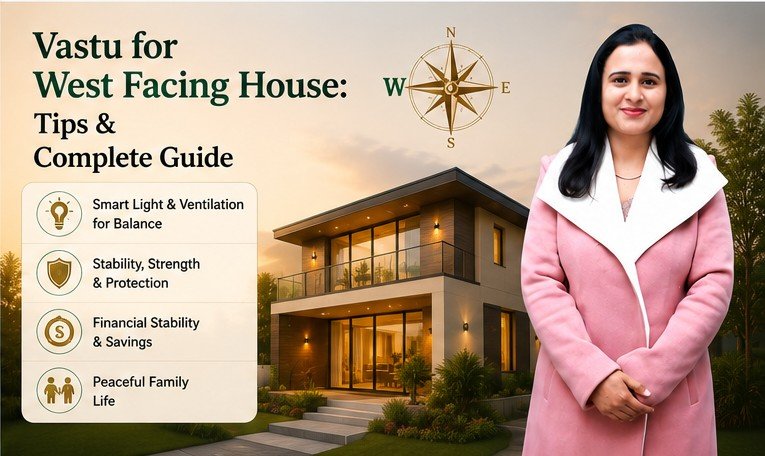
Vastu for West Facing House: Not As Bad As You Think

Acharya Nehha
Vastu ExpertWest facing house has an undeserved reputation in Vastu circles. I've watched clients reject perfectly good properties simply because the main entrance faces west — and that's a mistake. West isn't a bad direction. It's just different, and understanding it properly changes everything.
Busting the West-Facing Myth
Here's something I tell every client who comes to me worried about a west-facing home: west is not south. South-facing gets a more cautious assessment in Vastu because it's governed by Yama (the god of death) and requires more careful handling. West, by contrast, is governed by Varuna — the deity of water, cosmic order, and stability. It's a calm, grounding direction.
In my 15+ years of practice, I've worked with dozens of families in well-configured west-facing homes who are thriving — financially stable, professionally successful, and at peace at home. The direction didn't hold them back. What holds people back is a poorly placed main door, a wrongly assigned bedroom, or a neglected northeast corner. Those issues exist in east-facing homes too.
West is also the direction of the setting sun — it's associated with completion, results, and the harvest of effort. There's actually something very grounded and satisfying about west energy when it's properly channelled. Business owners in particular often do well in west-facing properties because the west supports commerce, material stability, and the rewards of hard work.
Main Door Placement on the West Wall
The west wall, like all walls in Vastu, is divided into 9 padas. The most favourable padas for your main door are 3, 4, 5, 7, and 8. This gives you a reasonably wide range to work with, which is one reason west-facing plots are often more flexible than they're given credit for.
Pada 1 on the west wall (toward the southwest corner) is problematic — it sits in the Nairuti zone, which carries heaviness and can bring obstacles. Pada 2 is marginal. Padas 3 through 5 in the central portion of the wall are clean and positive. Padas 7 and 8 toward the northwest are also generally acceptable — NW is associated with Vayu (wind, movement) and supports social connections and business activity.
Pada 9 at the far north-west corner needs care — it sits close to the transition between west and north zones, and placement here can create instability in relationships. If your door falls there, it's worth consulting a Vastu professional about a simple remedy.
Share your floor plan with Acharya Nehha for a quick professional review.
WhatsApp Acharya Nehha Book Consultation
Room Layout for a West Facing House
The internal layout rules in Vastu are largely consistent across directions — the zones are fixed regardless of which way your front door faces. Here's how to work with a west-facing home's internal spaces:
- Master bedroom: Southwest. Always. This rule doesn't change with direction. SW is your anchor of stability and rest.
- Kitchen: Southeast (Agni zone). If the flat or house design doesn't allow SE, the northwest is the secondary option.
- Prayer room: Northeast corner. Keep it clean, light, and uncluttered.
- Living room: North or northeast — supports positive movement and social energy.
- Children's room: West or northwest. The NW energy suits younger family members well.
- Guest room: Northwest. Guests are meant to come and go — NW energy supports exactly that kind of transient, social movement.
Managing Afternoon Sun in a West Facing Home
The one genuine challenge with a west-facing house is afternoon sunlight. Your living spaces get direct western sun in the late afternoon, which can create heat buildup — especially in summer months. This isn't a Vastu defect, it's just a practical consideration.
Solutions are straightforward: use warm-toned, light-absorbing curtains on the west-facing windows, plant medium-height shrubs or install pergolas to filter the afternoon light, and consider using lighter wall colours on the west-facing interior walls. These aren't remedies — they're just sensible design decisions for a west-facing home.
In terms of Vastu energy, afternoon sunlight is not harmful — it's simply a different quality of solar energy than morning light. If you're someone who's naturally more productive and alive in the afternoon and evening hours, a west-facing home might actually feel more comfortable to you than an east-facing one. I've noticed this with several clients.
The bottom line on west-facing: if the door is in the right pada, the NE corner is clean and open, the master bedroom is in SW, and the kitchen is in SE — you have a perfectly fine Vastu configuration. Don't let anyone talk you out of a good property just because it faces west.
At Prestigious Vastu, we give you an honest, complete assessment of your west-facing home — not fear, just facts and clear guidance.
Book Your Home Vastu ConsultationFrequently Asked Questions
Common questions about west facing house Vastu answered by Acharya Nehha