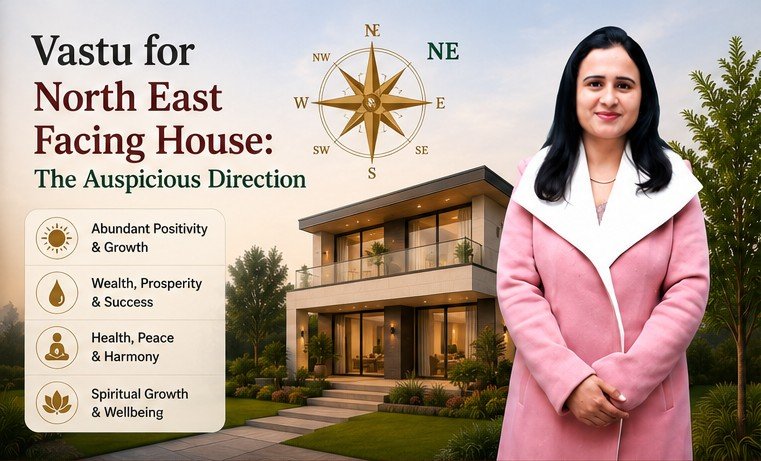
Vastu for North East Facing House: The Ishanya Zone

Acharya Nehha
Vastu ExpertA north-east facing house is considered the most auspicious orientation in Vastu Shastra. The northeast — called Ishanya — is the zone of the divine, of water, clarity, and spiritual growth. When your main entrance opens in this direction, you're literally inviting that energy into your life every time you walk through the door. But even with this powerful start, how you configure the inside determines how much of that potential you actually access.
Why the Northeast (Ishanya) Is So Sacred
In Vastu Shastra, the northeast corner is where the energies of north (Kuber — wealth) and east (Surya — life force) converge. This confluence creates what ancient texts describe as a zone of maximum positive potential. It's associated with the water element — not turbulent, rushing water, but still, clear water that reflects and clarifies. Spiritually, this direction supports meditation, prayer, learning, and inner peace.
The presiding deity of the northeast is Ishana — a manifestation of Shiva — and the zone is considered a direct channel for cosmic energy entering the home. When the entrance of a house faces northeast, that channel is wide open. You're drawing in the combined blessings of clarity, wisdom, prosperity, and spiritual alignment simultaneously.
In my 15+ years of practice, the NE-facing homes I've assessed tend to have a noticeably lighter, cleaner energy — a quality of ease that residents often describe even before they know anything about Vastu. That's not coincidence.
The Main Door in a NE Facing House
Having your main door face northeast is genuinely a significant blessing in Vastu. The northeast direction itself is considered the most auspicious for an entrance, so the placement rules here are more forgiving than, say, a south-facing home where only specific padas are acceptable.
That said, a few things still matter. Keep the entrance area clean, bright, and unobstructed. The immediate space inside the door — your foyer or entrance hall — should not be cramped, dark, or cluttered. Whatever energy the direction provides, the physical space either amplifies or throttles it. A beautiful northeast-facing door that opens into a dark, shoe-filled corridor is a missed opportunity.
Also avoid placing your main gate or compound entrance in a way that blocks the northeast corner of the plot. The NE corner of the overall property should ideally be lower than the rest of the plot, open, and free — it should feel like the property is welcoming energy in, not blocking it.
Acharya Nehha reviews floor plans and identifies what's working — and what's blocking your home's full potential.
WhatsApp Acharya Nehha Book Consultation
What to Keep Light and Open in a NE Zone
The northeast zone — whether it's the corner of your plot, your house, or each individual room — must be kept light, open, and uncluttered. This is the single most important ongoing rule for a NE-facing home. The Ishanya zone is like a receiver for cosmic energy: anything heavy you place there blocks the signal.
Specifically, avoid the following in the northeast zone:
- No toilets or bathrooms in the NE corner. This is one of the most serious Vastu defects in any home, but it's especially damaging in a NE-facing house. A bathroom here pollutes the zone that's supposed to carry your home's highest energy.
- No heavy storage or furniture. Almirahs, storage units, or dense furniture in the NE corner press down on the zone's lightness.
- No staircase in the NE. A staircase here is a heavy, descending structure placed directly in the most energetically active corner — it suppresses the upward, expansive quality of the Ishanya zone.
- No kitchen in the NE. Fire and the water-element NE zone are fundamentally incompatible. A kitchen here creates continuous friction.
- No septic tank or underground water in the SW. Keep your heavy elements (tanks, solid furniture) in the SW and keep NE light. The contrast between heavy SW and light NE is exactly how Vastu energy flows correctly.
Room Layout and the NE Facing Home
Here's how to assign rooms in a north-east facing house for maximum positive effect:
- Prayer room: Northeast — it's the perfect home for a pooja space, and the spiritual quality here is unmatched.
- Master bedroom: Southwest. Non-negotiable. The head of the household should always anchor the SW zone.
- Kitchen: Southeast (Agni corner). Fire belongs in the fire zone.
- Children's room: West or northwest for younger children; east for students who need focus and growth energy.
- Living room: North or east — both support positive social energy and conversations.
- Home office or study: North-facing desk position is ideal for concentration and career success.
Here's the honest part — and I say this with genuine care: I've worked with clients who owned beautiful north-east facing homes and were still struggling. In every case, the issue wasn't the direction. It was a toilet in the NE corner, or the master bedroom in the north instead of SW, or a staircase pressing down on the Ishanya zone. Direction is the starting blessing. What you do with the interior is where the real Vastu work happens. If you're not getting the results you expected from a NE-facing home, a professional assessment will almost always reveal the cause.
At Prestigious Vastu, we help you unlock the full potential of your north-east facing home with a thorough, practical assessment of every zone.
Book Your Home Vastu ConsultationFrequently Asked Questions
Common questions about north east facing house Vastu answered by Acharya Nehha