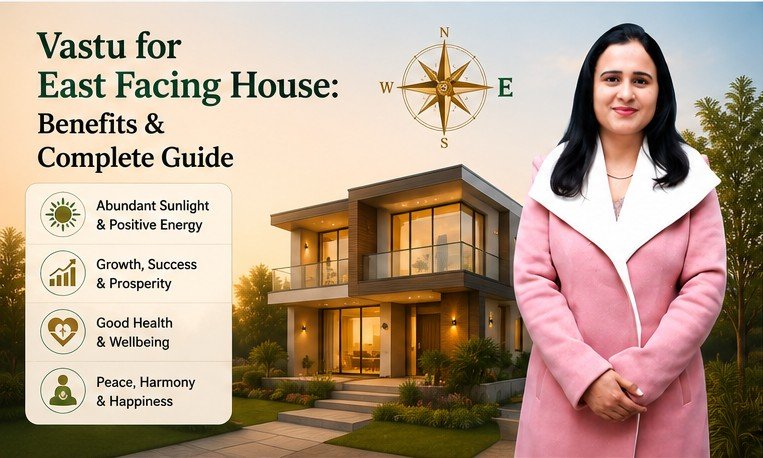
Vastu for East Facing House: Why It's Considered Auspicious

Acharya Nehha
Vastu ExpertAn east facing house is widely regarded as auspicious in Vastu Shastra — and for good reason. But "east facing" alone doesn't guarantee good energy. Where your main door sits on that east wall, how your rooms are arranged inside, and a few things you should never do — all of it shapes the actual outcome.
Why East Is Associated With Surya and Morning Energy
In Vastu Shastra, every direction is governed by a deity and an element. The east is ruled by Surya — the sun god — and it's the direction of the rising sun, new beginnings, and life energy. The morning sunlight that enters from the east is considered the most beneficial: it's warm, activating, and carries prana (vital energy) in its purest daily form.
Over 15 years of consultations, I've noticed something consistent: families in well-configured east-facing homes tend to report a lighter, more optimistic atmosphere. There's a reason for that. Natural morning light is deeply connected to our body's rhythms — it wakes us up properly, regulates mood, and sets a positive tone for the day. Vastu formalises what we already feel intuitively.
East is also associated with intellectual and professional growth. If knowledge, career, or reputation are important to you — and honestly, when aren't they — an east-facing orientation starts you on the right foot.
Main Door Placement on the East Wall: The Pada System
Here's where I see the most confusion among homeowners. People assume that any east-facing door is fine. It isn't. The east wall is divided into 9 equal segments called padas, numbered 1 through 9 from south to north. The ideal padas for your main door on an east wall are pada 3, 4, and 5 — these fall in the central and slightly north-central portion of the wall.
Pada 1 and 2 in the southeast corner of the east wall are considered problematic — they sit close to the Agni (fire) zone, which can create tension and health issues in the household. Pada 8 and 9 toward the northeast corner are generally fine but require care so you don't inadvertently burden the Ishanya (NE) zone. Padas 3, 4, 5 — that central sweet spot — bring positive energy in cleanly.
If you're buying a ready-made home and the east door is in pada 1 or 2, don't panic. There are Vastu remedies that can neutralise the impact without structural changes. But if you're building or choosing between units, insist on the central padas.
Send Acharya Nehha your floor plan and get a quick assessment within 24 hours.
WhatsApp Acharya Nehha Book Consultation
Room Layout for an East Facing House
Once the door is sorted, the internal layout is your next priority. Here's what works well in a Vastu-aligned east-facing home:
- Master bedroom: Southwest zone. This is non-negotiable regardless of which direction your house faces. SW gives stability, authority, and deep rest.
- Kitchen: Southeast zone — the Agni (fire) corner. Cooking in the SE supports health and nourishment. If SE isn't available, the northwest is the next best option.
- Prayer room (pooja room): Northeast zone — Ishanya. The NE is the most spiritually charged direction, and a prayer space here amplifies its positive effects beautifully.
- Children's room: West or northwest works well. North is also acceptable for younger children still in the learning phase.
- Living room: North or northeast. These directions support movement, social energy, and positive interactions.
- Study or home office: North or east walls facing north — ideal for concentration and career growth.
What NOT to Do in an East Facing House
An east-facing house is genuinely one of the easier orientations to work with — but there are a few things I see go wrong repeatedly.
Don't block the east wall with large trees or structures. Morning sunlight should flow into the home freely. A massive tree or a boundary wall right at the east entrance cuts off the very energy you're benefiting from. Keep the east open and well-lit.
Don't create heavy storage or clutter in the SW. If the SW quadrant of your home is piled with junk, unused furniture, or general storage mess, you're undermining the stability that zone is supposed to provide. The SW should feel grounded and settled, not chaotic.
Don't place a toilet or bathroom in the northeast corner. Even in an east-facing home with otherwise good orientation, a NE bathroom is a significant Vastu defect. It contaminates the Ishanya zone and can create obstacles in health and spiritual well-being.
Don't ignore the slope of the land. If your east-facing plot slopes toward the west, that can create issues. Ideally, plots slope toward the north or east for positive energy flow. This matters especially if you're choosing a plot.
I've worked with clients who bought east-facing homes expecting automatic good fortune, then couldn't understand why things weren't clicking. Direction is a starting point — not the whole answer. The internal configuration, the way you use each room, and even your own intentions in the space all play a role. That said, east facing is a genuine advantage, and with the right layout, it's a home that supports growth naturally.
At Prestigious Vastu, we assess your east-facing home's full layout — door placement, room zones, and remedies — so you get the energy your home was always meant to provide.
Book Your Home Vastu ConsultationFrequently Asked Questions
Common questions about east facing house Vastu answered by Acharya Nehha