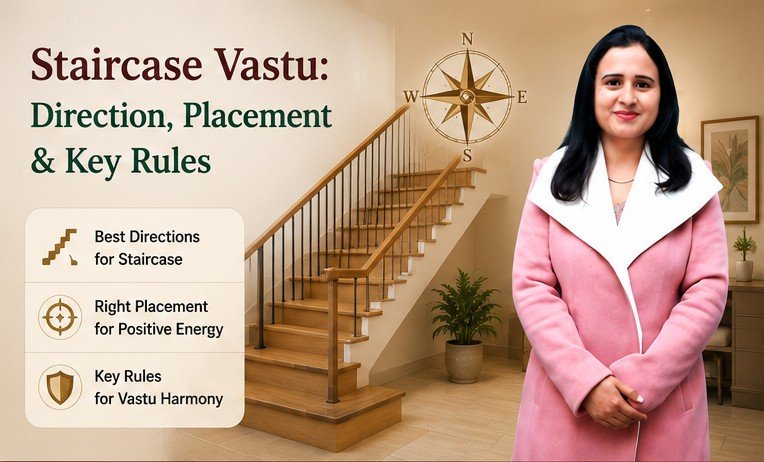
Staircase Vastu: Why Your Stairs Affect the Whole House

Acharya Nehha
Vastu ExpertMost people think about individual rooms when they approach Vastu. They fix the bedroom, sort out the kitchen, maybe think about the entrance — and forget about the staircase entirely. In my practice, the staircase is one of the most impactful structural elements in any multi-storey home, precisely because it connects floors and channels energy vertically through the entire building.
Why Staircase Placement Matters in Vastu
Think of the staircase as an energy channel. It's the pathway through which the energy of your home travels from one level to the next. If it's placed in the wrong zone, it actively pulls energy from that zone and redirects it — often creating imbalance that shows up as persistent health issues, financial instability, or relationship friction that residents can't trace back to any obvious cause.
The staircase also has weight. It's a heavy structural element, and Vastu assigns directional significance to where heavy elements sit in a home. The heavier, more grounding elements belong in the South, Southwest, or West — not in the North or Northeast, which should remain lighter and more open.
Best Direction for a Staircase
The preferred directions for staircase placement are South, Southwest, or West. These zones can accommodate the weight and structural heaviness of a staircase without disrupting the energy balance of the home. If you're building from scratch or doing a major renovation, positioning your stairs in one of these three zones is the single most impactful Vastu decision you can make for a multi-storey home.
The staircase should ideally wind clockwise when going upstairs — meaning it turns from left to right as you ascend. This aligns with the natural movement of solar energy and is considered auspicious in Vastu.
Also important: the staircase should not touch or be placed against the North wall. The North wall governs career and wealth energy, and a staircase pressing against it creates unnecessary pressure on that zone.
The Most Serious Staircase Violation — Northeast Placement
A staircase in the Northeast corner is one of the most serious Vastu violations I encounter. The Ishanya zone is the lightest, most sacred part of any home — associated with water, clarity, and divine energy. Placing a heavy, structural staircase here destroys this zone completely. Clients with NE stairs frequently report health problems that seem to cycle without resolution, a persistent sense of confusion or poor decision-making, and an inexplicable heaviness in the home despite it looking fine on the outside.
Equally problematic is a staircase placed in the centre of the house — the Brahmasthan. The centre point is meant to be open, light, and energetically unobstructed. Any heavy structural element here — including a staircase — creates a blockage at the core of the home's energy system.
Acharya Nehha can assess the full impact and recommend practical remedies for your specific floor plan.
WhatsApp Acharya Nehha Book Consultation
Step Count, Condition, and the Space Beneath
The number of steps matters. In Vastu, odd numbers are preferred — 15, 17, 19, 21 are all good counts. The key rule is that the count should not end on a zero. The reasoning is rooted in the principle of completion: a staircase that ends on a "complete" number creates closure, whereas odd numbers leave the energy continuing to move upward.
The condition of your stairs is also significant. Broken or cracked steps are considered very bad Vastu — they represent instability in the energy path between floors. If you have a broken step, repair it immediately. This is not a superstition; it's a practical principle about maintaining the integrity of your home's structure.
The space under the staircase is one of the most misused areas in Indian homes. What you should never place beneath your stairs: a kitchen, a toilet, or a shrine. A pooja room under the staircase is considered particularly inauspicious — placing a sacred space in a transitional, weight-bearing area is disrespectful to the energy of worship and disrupts both the staircase zone and the prayer space simultaneously. A storage cupboard under the stairs is generally acceptable, provided it's kept organised and clean.
For a complete home Vastu assessment, the staircase is always one of the first things I evaluate — because its placement sets the energetic tone for every floor of your home.
At Prestigious Vastu, we assess staircase placement as part of a full home energy map — identifying corrections and remedies that work with your existing structure.
Book Your ConsultationFrequently Asked Questions
Common questions about staircase Vastu and placement rules